
If you have ever watched a volleyball game and wondered why players run to new spots the moment the ball is served, you have seen a rotation system at work. Every team must start each rally in a fixed order, but where players line up is not where they play.
This guide explains the three systems you will see in Calgary gyms, from Grade 6 house leagues to club: the 4-2, the 6-2 and the 5-1. Each one comes with a diagram showing where players stand at the serve and where they move to play.
Quick comparison
| System | Setters | Front-row attackers | Best for |
|---|---|---|---|
| 4-2 | 2, setting from the front row | 2 (outside and middle) | Beginners and younger teams |
| 6-2 | 2, setting from the back row | 3 in every rotation | Developing teams with two setters |
| 5-1 | 1, setting in all six rotations | 3 when the setter is back row, 2 when front row | Older, competitive and club teams |
The two numbers describe the lineup: the first is how many players attack, the second is how many players set.
Start here: the six zones
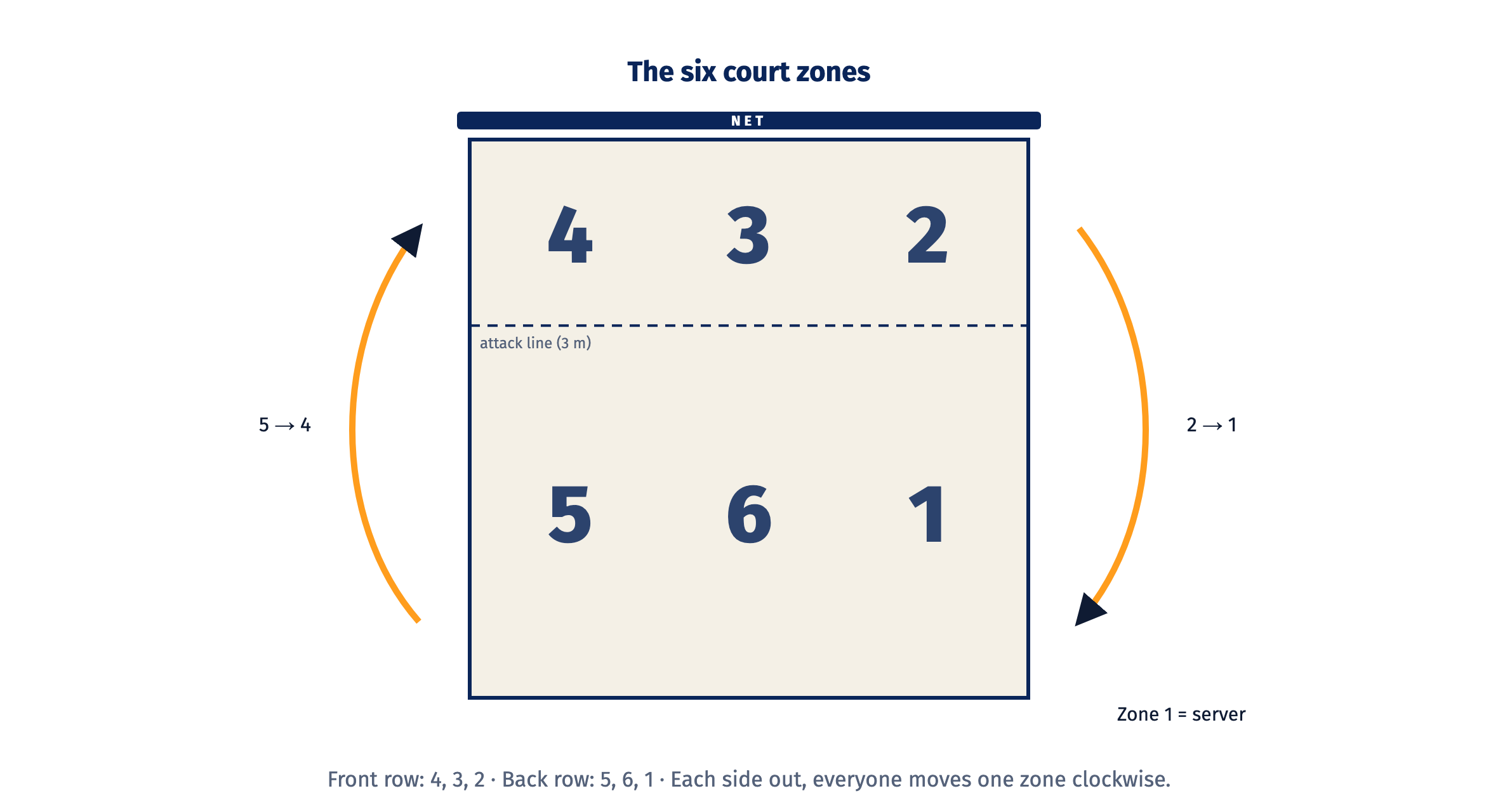
A volleyball court is split into six zones. The front row is zones 4, 3 and 2 (left to right, facing the net). The back row is zones 5, 6 and 1. The player in zone 1 serves.
Each time your team wins the serve back (a side out), everyone moves one zone clockwise. The player in zone 2 moves to zone 1 and serves next.
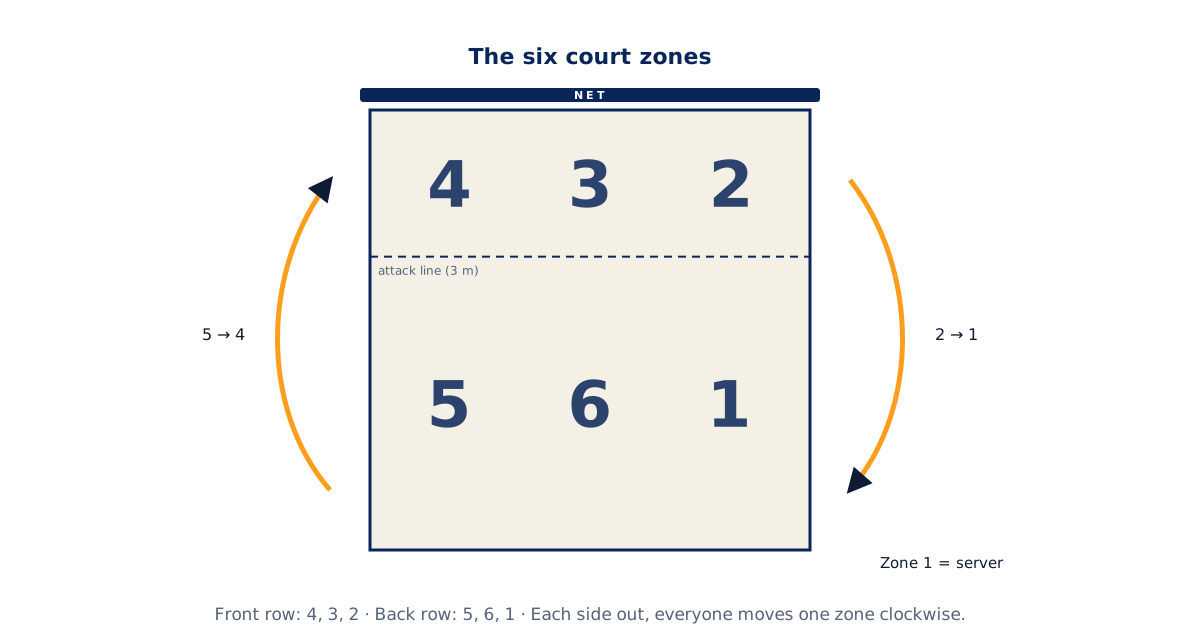
The six court zones. Players rotate clockwise each time their team wins back the serve.
Starting rotation vs base position
Starting rotation is where players must stand when the ball is served. At that moment, each player has to be in the right order next to their neighbours:
Each front-row player must be closer to the net than the back-row player directly behind them (4 ahead of 5, 3 ahead of 6, 2 ahead of 1).
Within each row, players must stay in left-to-right order (4 left of 3, 3 left of 2, and 5 left of 6, 6 left of 1).
If two players are out of order, the referee calls an overlap and the other team gets the point.
Base position is where players move once the ball is served. Now they can go anywhere, so each player switches to the spot where they play best: setters to the setting target near the net on the right, outside hitters to the left, middles to the middle.
In the diagrams below, the left court shows the starting rotation and the right court shows the base position. A dotted ring marks where each player started.
The 4-2: two setters, setting from the front row
In a 4-2, the two setters line up opposite each other, so one is always in the front row. Whoever is in the front row sets. The other setter plays in the back row like any other player.
In the rotation shown, Setter 1 starts in zone 2 (right front), so there is no switch to make: they stay at the net and set. The outside hitter and middle blocker are the two attackers.
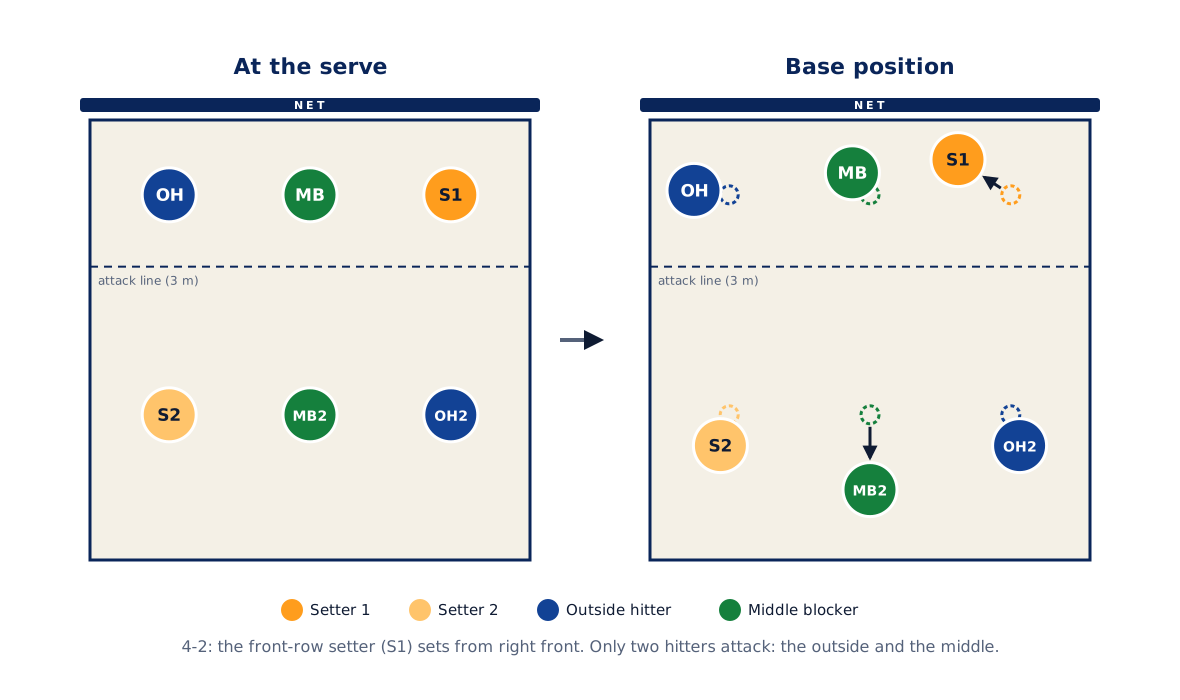
4-2 rotation: Setter 1 sets from right front. Only two front-row players attack.
Pros and cons
Pros: the easiest system to learn. The setter is always close to the net, so the second contact is short and simple. Two players get setting experience.
Cons: only two front-row attackers, which makes the offence easier to block. Setters are also blockers, so short setters can be a target.
The 6-2: two setters, setting from the back row
A 6-2 also uses two setters lined up opposite each other, but the setter who is in the back row sets. The front-row setter becomes a hitter and attacks from the right side.
In the rotation shown, Setter 1 starts in zone 1 (right back). As soon as the ball is served, Setter 1 runs in ("penetrates") to the setting target at the net. Setter 2 starts at left front and switches to right front to hit. The outside hitter switches from right front to left front.
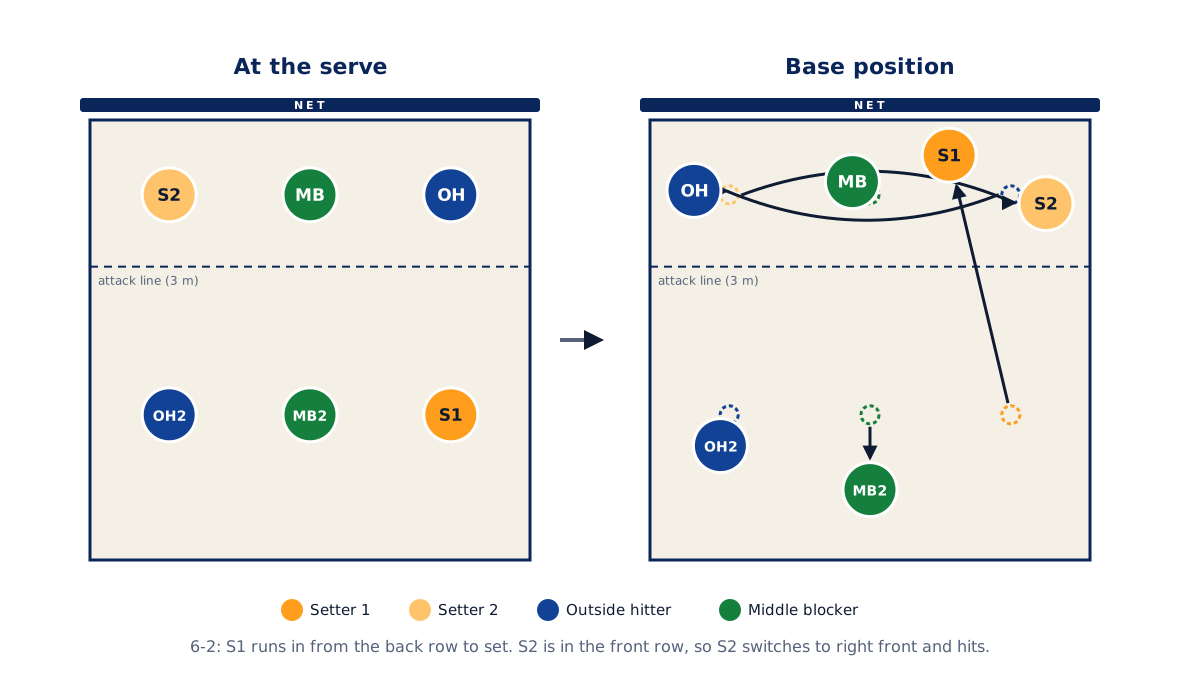
6-2 rotation: Setter 1 runs in from the back row. Setter 2 switches to right front and hits as the opposite.
Pros and cons
Pros: three front-row attackers in every rotation, so the offence is harder to read and block. Two players develop as setters.
Cons: more switching, which takes practice. Two setters need similar skill, or the offence changes every three rotations. Both setters also need to be able to hit.
The 5-1: one setter in every rotation
A 5-1 uses one setter for all six rotations, with five hitters around them: two outside hitters, two middle blockers and an opposite who lines up directly across from the setter.
When the setter is in the back row, the team has three front-row attackers, like a 6-2. When the setter rotates into the front row, there are only two, like a 4-2, but the setter can also attack the second ball ("dump").
The rotation shown is the hardest one: the setter starts at left front and has to switch all the way to the right side. The outside hitter moves to left front, the middle moves to the middle, and the libero replaces the back-row middle blocker.
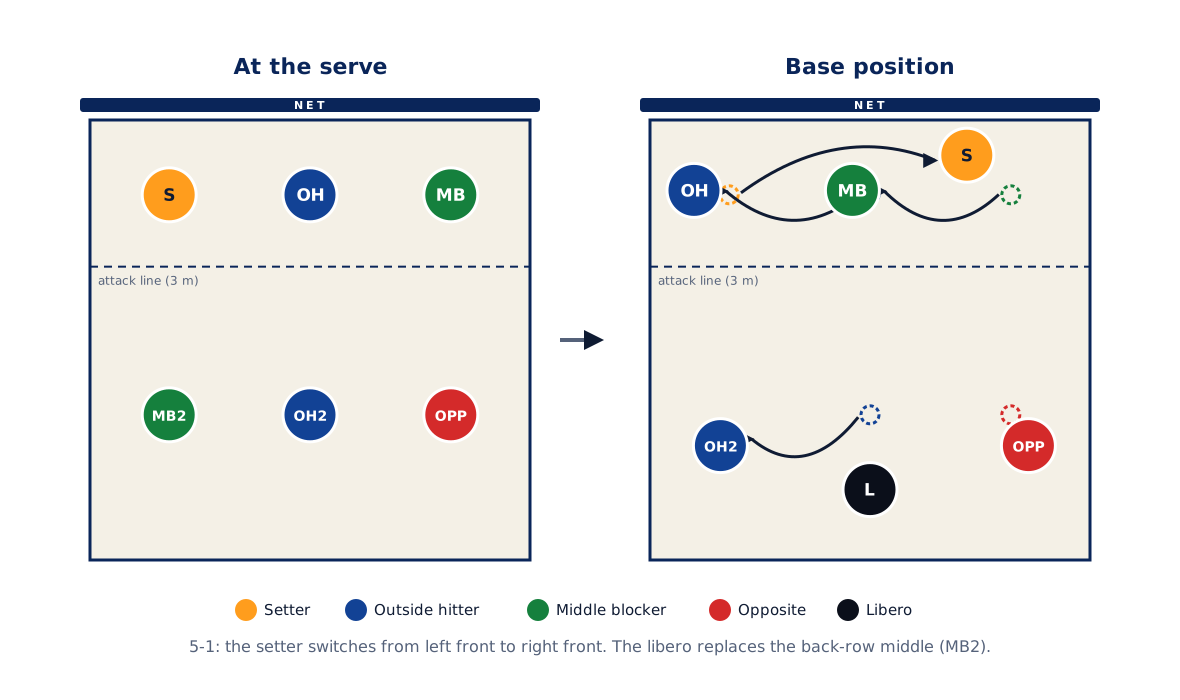
5-1 rotation: the setter switches from left front to right front. The libero takes the back-row middle spot.
Pros and cons
Pros: one setter means one rhythm. Hitters get the same sets from the same person every rally, which builds timing. Most high school, club and university teams use it.
Cons: the setter carries a heavy load and needs strong footwork to reach the target from every rotation. Three rotations have only two front-row attackers.
Which system should your team run?
| Level | Usual system | Why |
|---|---|---|
| Beginners and younger players (about Grades 4–7) | 4-2 or 6-2 | Keeps the setter close to the net and lets more players learn to set. |
| Developing teams (about Grades 7–9) | 6-2 | Three attackers in every rotation while two setters keep developing. |
| Competitive, high school senior and club teams | 5-1 | One consistent setter and a clear role for every hitter. |
In VISION programs, younger athletes learn every position before they specialise. Coaches introduce rotations step by step, so players understand why they move, not just where.
Three common rotation mistakes
Overlapping at the serve. Players start switching before the ball is contacted. Wait for the serve, then move.
A late setter. In a 6-2 or 5-1, the back-row setter must leave as soon as the ball is served, or the pass arrives before they do.
Hitters who do not transition. After a block or a dig, attackers need to get back off the net to their approach spot so they are ready for the next set.
Common questions
What is the easiest volleyball rotation for beginners? The 4-2. The setter is always in the front row, close to the net, so there is less running and the second contact is short.
What does 5-1 mean in volleyball? Five hitters and one setter. The same setter sets in all six rotations.
What is the difference between a 6-2 and a 5-1? A 6-2 has two setters who each set only from the back row, so there are always three attackers. A 5-1 has one setter who sets from every rotation.
Learn rotations on the court
Diagrams help, but rotations click when you run them. Volleyball Calgary programs at the VISION Sport Centre (7475 Flint Road SE) teach the 4-2, 6-2 and 5-1 as athletes move up, from first-time camps to club teams.
See Calgary volleyball programs
New to volleyball? Try a free camp.
Learn the language first: read Volleyball Terms Every New Player Should Know.