
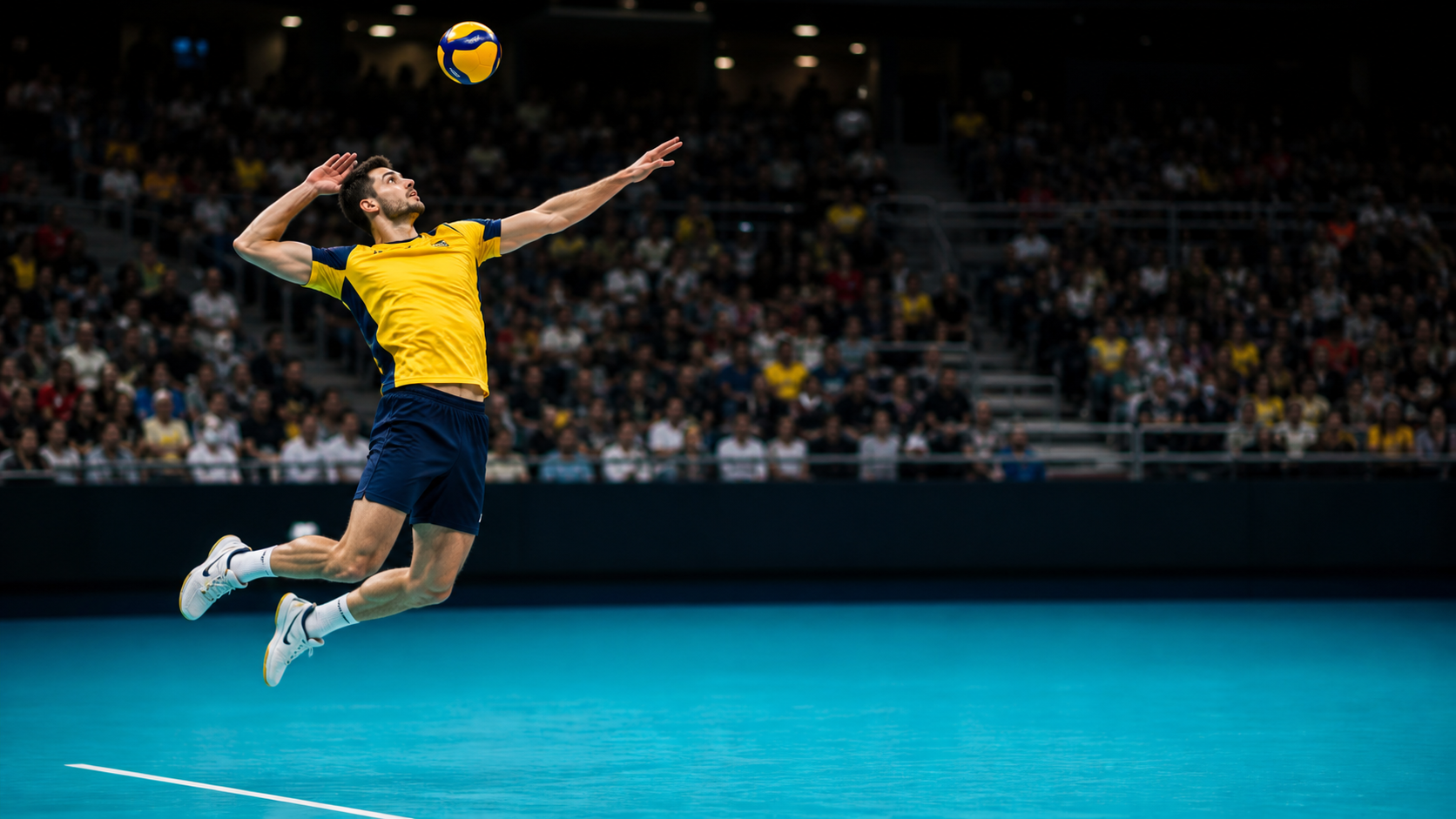
I remember the first time one of my athletes landed a clean jump serve in a real match. She’d been working on it for weeks — toss after toss, approach after approach, a lot of balls into the net, a lot of frustrated sighs. Then one day it just clicked. She stepped back, tossed it high, ran in, and hammered it into the back corner. The other team didn’t move. Neither did we, honestly. We just looked at each other.
That’s what the volleyball jump serve does. When it comes together, it feels like a superpower.
But getting there takes more than wanting it. It takes the right foundation, the right progression, and a coach who knows when to push and when to slow down. That’s what this guide is about.
So, What Exactly Is a Volleyball Jump Serve?
If you’ve watched elite volleyball recently, you’ve seen it. A player walks all the way back behind the end line, tosses the ball way up in the air, takes a running approach like they’re about to spike, jumps — and absolutely blasts it over the net. That’s the volleyball jump serve, and it’s become one of the most feared weapons in the sport.
What makes it so hard to deal with is the topspin. The ball comes off the server’s hand spinning forward, so it travels fast and then drops sharply. From the passer’s side, it can look like it’s sailing long — and then it dives into the court at the last second. That moment of doubt? That’s exactly what the server is counting on.
It Didn’t Start Out Looking Like This
The jump serve wasn’t invented in a coaching clinic. It grew out of someone’s curiosity back in the 1980s — probably some player who thought, “Wait, I can spike a ball going 80 km/h… so why am I just standing here to serve?” Early attempts were ugly. Lots of net balls, lots of wide serves, lots of coaches shaking their heads.
But a few stubborn players kept at it. By the 1990s you started seeing it at the international level. By the 2000s it was everywhere. Today, at the highest levels of the sport, it’s basically expected. If you can’t jump serve with real power and consistency, you’re already at a disadvantage.
Why Is It So Hard to Pass?
Here’s the thing — a well-executed jump serve doesn’t just challenge passers physically. It messes with them mentally. And it does it on multiple levels at once.
Speed is the first problem. We’re talking 80 to 100 km/h. That’s not a lot of time to read the trajectory, move your feet, and get your platform where it needs to be. Most of the decision-making has to happen before the ball even gets close.
Topspin is the sneaky part. Unlike a float serve that drifts unpredictably, a topspin jump serve has a clear path — it just drops way faster than passers expect. They see it going long, they hesitate, and by the time they commit, it’s already on the floor.
Contact angle is the third factor. Because the server is jumping and making contact six feet in the air, they can push the ball into corners and gaps between passers that simply aren’t accessible from a standing position. The geometry of the court changes.
Momentum might be the biggest factor of all. One ace at 24-23 in the fifth set doesn’t just win a point. It can flip the entire energy of a match. That’s why elite coaches treat their best servers almost like closers in baseball — saved for the pressure moments.
Jump Serve vs Float Serve — Which Should Your Athlete Learn First?
This comes up all the time, and the honest answer is: float serve first, almost always.
A float serve has little or no spin, which causes it to drift and move unpredictably in the air. It’s its own kind of nightmare for passers, and it’s a lot easier to control for the server. It teaches the fundamentals — toss consistency, clean hand contact, target awareness — without the added complexity of a full approach and jump.
The jump serve comes later. Once your athlete can serve with real consistency, once they understand their body in the air and have a reliable toss, that’s when you start building the jump serve. Trying to shortcut that progression usually means building bad habits that take twice as long to fix.
How the Jump Serve Is Reshaping Elite Volleyball
This is where it gets interesting beyond just technique. The volleyball jump serve isn’t just a cool skill — it’s quietly changing how the whole sport is built.
Rosters are being built around it. Coaches at the club and national level now recruit with serving ability in mind almost as seriously as attacking. A player who can drop a consistent 90+ km/h jump serve while keeping it in bounds isn’t just a nice bonus — they’re a tactical weapon.
Defense has had to evolve. Liberos — the specialists whose whole job is passing and defense — are spending more and more training time specifically on handling high-speed topspin serves. Rotations are being redesigned. Coaches are working hard to keep their best passers in serve-receive for as long as possible.
Serving is now a strategy, not just a formality. At higher levels, nothing is random. Coaches call serving targets. They go at weaker passers. They serve short to disrupt the setter’s rhythm. They attack the seam between two players. The best young athletes need to start thinking this way too: not just “how hard can I serve,” but “where am I serving, and why?”
When Is an Athlete Ready to Learn the Jump Serve?
There’s no magic age. There’s a readiness level.
Before a player should even start working on a volleyball jump serve, they need a consistent standing serve. Not “they can get it over most of the time” — actually consistent. They should understand their toss, know their contact point, be aware of their shoulder position and follow-through, and have a sense of where they’re targeting.
The jump serve adds a whole other layer of coordination: toss, approach footwork, jump timing, arm swing, landing. If the foundation isn’t solid, adding all of that at once usually means chaos — a player chasing a bad toss mid-approach, making awkward contact, and ingraining the wrong muscle memory.
When the foundation is there? That’s when the jump serve becomes exciting to develop instead of frustrating.
A Step-by-Step Progression That Actually Works
Here’s the progression we use at Vision Elite Academy. It’s not about getting to the jump serve fast. It’s about getting there right.
1. Lock in a consistent standing serve first. Can’t skip this.
2. Add topspin to the standing serve. Practice clean, forward hand snap at contact.
3. Work the toss in isolation. Throw it, catch it, repeat. It should land in the same spot every time.
4. Walk through the approach footwork without the ball. Left-right-left (for right-handers) until it’s automatic.
5. Combine the toss and approach at half speed. No big swing yet. Just feel the timing.
6. Add contact. Focus on hitting high and slightly in front of the shoulder. Topspin, not a flat slap.
7. Aim deep before aiming hard. Consistent placement in the deep zones first.
8. Then add power gradually. Track serve percentage in every practice — if it drops below 70%, dial back the pace.
The Mistakes We See Most Often (And How to Fix Them)
The toss is all over the place. This is the number one killer of jump serves at every level. If the toss isn’t consistent, nothing else can be. Drill the toss separately until it’s automatic. Seriously — just the toss, over and over.
Contact point is too low. Jumping but hitting at the same height as a standing serve defeats the whole purpose. Work on reaching full extension and contacting the ball at the peak of the jump.
Going for power before control. This is the most common mistake with athletes who are excited about the skill. A serve that misses is worse than a mediocre serve that goes in. Build accuracy first, always.
Landing out of control. Players should land balanced, on both feet, ready to transition. Falling forward into the court is a sign the approach is off or the toss is pulling them off-balance.
Serving without a target. The jump serve should never just be “hit it hard and hope.” Even in practice, every serve should have a zone or a purpose. That habit is what separates good servers from great ones.
Is the Jump Serve Right for Youth Athletes?
Yes — but with the right framework around it.
When it’s taught well, the jump serve does a lot for young players beyond just serving. It builds explosiveness. It develops rhythm and timing. It gives athletes confidence at the line. And it teaches something really important: that serving isn’t just the way you start a rally. It’s an offensive weapon.
The risk is rushing it. A kid who misses six jump serves in a set isn’t helping their team, no matter how good the skill looks in warmups. Coaches need to monitor serve percentage honestly and give athletes clear benchmarks for when they’ve earned the right to use it in competition.
The rule we live by: show me you can control it, then I’ll let you use it. That keeps development honest and keeps athletes motivated to actually master the skill instead of just showing off.
Frequently Asked Questions
How fast is a volleyball jump serve?
At the elite level, jump serves typically travel between 80 and 100 km/h. Some of the most powerful servers in international volleyball exceed that. For youth and high school athletes, anything consistent in the 60–75 km/h range with good placement is genuinely effective.
How do you jump serve in volleyball?
Toss the ball high and slightly in front of your hitting shoulder, take a three-step approach (left-right-left for right-handers), jump off both feet, reach full extension, and contact the ball with a forward snap of the wrist to generate topspin. Landing should be balanced, inside the court.
Is a jump serve harder to learn than a float serve?
Yes, significantly. A jump serve requires timing, coordination, a reliable toss, and consistent approach footwork — all happening at the same time. Most coaches recommend mastering a standing topspin serve before introducing the jump serve.
What age should athletes start learning the jump serve?
It depends more on readiness than age. Once an athlete has a consistent standing serve, understands their mechanics, and has the coordination to manage the approach and toss simultaneously, they’re ready to start the progression. For many athletes that’s around 13–15, but it varies.
Is the jump serve legal in volleyball?
Yes, fully legal under FIVB rules. The server just needs to contact the ball within the service zone and cannot step on or over the end line before making contact.
Should beginners try to learn the jump serve?
Not right away. Beginners should first build a reliable standing serve. Once that’s solid, they can start the progression toward a jump serve. Trying to skip the foundation usually creates more problems than it solves.
Final Thoughts
The volleyball jump serve is one of the most rewarding skills in the game to develop — for athletes and coaches alike. There’s nothing quite like watching a player who’s put in the work finally land it with confidence in a real match.
But the path there isn’t about shortcuts. It’s about building the right foundation, respecting the progression, and trusting the process even when it’s slow. The athletes who do that are the ones who show up in the fifth set with a weapon — not just a flashy skill they can’t control.
Every great jump server started exactly where your athlete is right now. The difference is just what they did from there.