
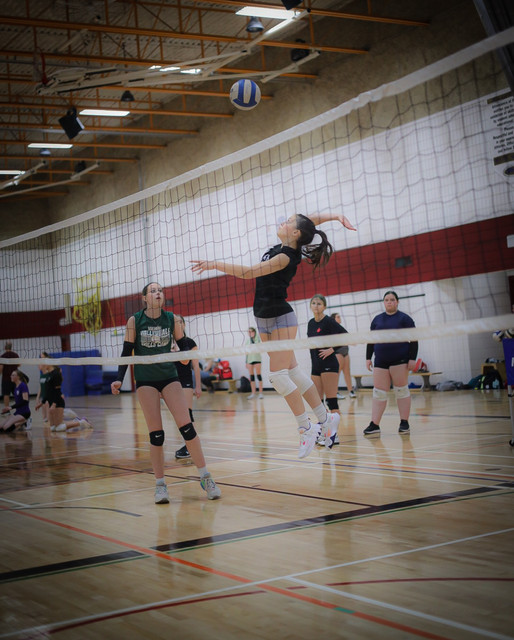
Early specialization is often framed as commitment. More reps. More focus. Faster progress.
And in the short term, it can look like it’s working—especially for hitters. Athletes score points early, look dominant against peers, and are rewarded for production.
But over time, early specialization quietly creates patterns that limit adaptability, consistency, and long-term growth.
Many of the most common hitting errors we see each season don’t come from lack of effort or coaching—they come from development that narrowed too soon.
What early specialization looks like in hitting
Early specialization often means: • playing one position exclusively at a young age • repeating the same attack patterns year-round • training primarily in structured systems • prioritizing output over exploration Athletes learn what works now—but not why it works, or when it won’t.
That’s where problems begin.
Error #1: One-speed swinging
Specialized hitters often learn to swing at one speed—full power. It works early because defenders are slower and blocks are inconsistent. But as the game speeds up, one-speed attackers lose margin.
They struggle to: • adjust to off-tempo sets • hit efficiently against strong blocks • control errors late in matches Power becomes their only solution—even when it’s the wrong one.
Error #2: Poor adaptation to set quality
Hitters who specialize early are often trained in highly controlled settings with consistent sets.
When passes drift or tempo changes, these athletes: • mistime approaches • contact the ball too low or too late • force swings instead of adjusting They haven’t learned to solve hitting problems—only to repeat familiar ones.
Error #3: Limited shot selection
Early specialization often delays the development of shots.
Athletes are rewarded for kills, not for range. Over time, they lose comfort with: • roll shots • tips • high hands • deep corner placement When power stops working, they don’t have alternatives they trust.
Error #4: Inefficient approach patterns
Repetition without variation can lock in approach habits that only work in specific systems. Common signs: • drifting into the ball • inconsistent spacing • poor balance at takeoff • limited ability to adjust approach length These issues don’t always show up early—but they surface under pressure.
Error #5: Reading the game too late
Specialized hitters are often told where to hit instead of learning to read the block and defense. As a result: • decisions happen mid-swing • hitters force balls into closed blocks • adjustments come too late Hitting becomes reactive instead of intentional.
Why these errors take time to appear
Early specialization doesn’t cause immediate breakdowns. It delays them. Athletes progress quickly early on, then plateau—or regress—when the game demands adaptability, not repetition.
That timing often confuses parents: “They were so successful before—what changed?”
The answer is usually the environment, not the athlete.
How strong programs offset early specialization
Good development environments intentionally widen skill exposure: • athletes play multiple roles early • hitting is trained with varied tempos and situations • decision-making is emphasized over patterns • mistakes are treated as information, not failure This doesn’t slow development—it protects it.
What parents should understand
If your athlete is encountering new hitting struggles after years of success, that’s not a step backward. It’s often the moment when deeper learning begins. Retraining adaptability takes time—but it raises the athlete’s ceiling.
The bigger picture
The most effective hitters aren’t the ones who specialized earliest.
They’re the ones who learned to: • adjust under pressure • control pace and contact • read the game • expand options as competition improves Early specialization can win early.
But adaptable hitters last longer—and go further.
Coach Luc Tremblay is the Founder and Head Coach of Volleyball Winnipeg. Luc has been coaching volleyball for 30+ years with athletes of all age classes and all abilities. He has developed most of the training techniques used by VISION coaches and is responsible for the coach development program at Volleyball Winnipeg. For more details on our Coach Resources, click here.